
Block, Anthropic, and Stripe Just Showed You What Offense Looks Like. Your Competitors Aren’t Ready.
The companies winning the AI era aren't cutting costs. They're replacing the coordination layer that's governed every organization since the Roman legions — and they're doing it at a speed bureaucratic competitors can't match.
THE NUMBER: 1,300 — pull requests shipped per week by Stripe’s AI agents, with zero human-written code. Not copilot-assisted code. Not AI-suggested code. Agent-written, human-reviewed, production-deployed code. That’s not a productivity story. That’s an entirely new operating model — and Stripe isn’t the only one running it.
On February 27, we wrote about Jack Dorsey firing 4,000 people at Block and the stock going up. We called it “The Dorsey Playbook” — AI-enabled layoffs as a market-positive announcement. We were right about the signal. We were wrong about the scope.
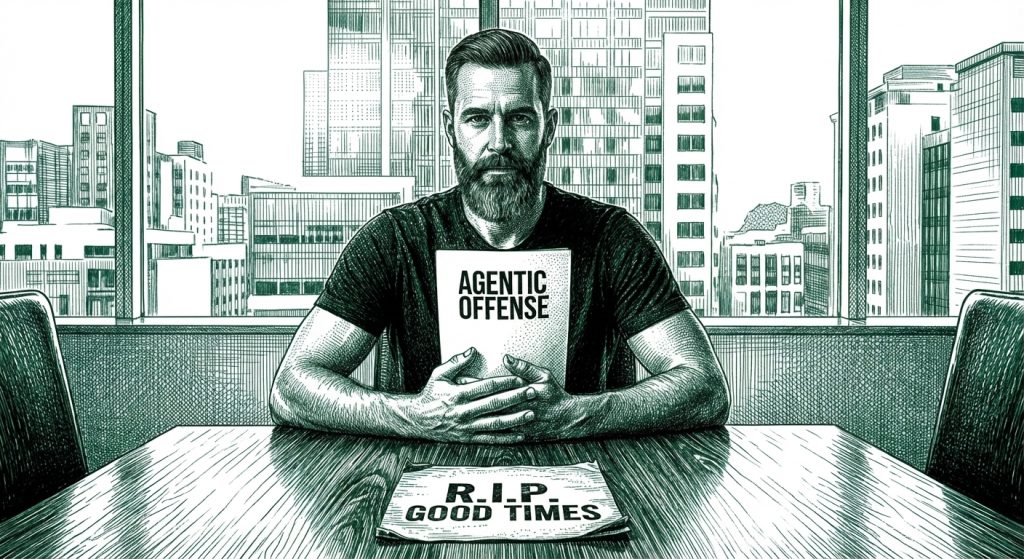
Yesterday, Dorsey and Roelof Botha — managing partner at Sequoia Capital — co-published a 3,000-word organizational manifesto called “From Hierarchy to Intelligence.” This isn’t a CEO blog post. This is the most influential venture firm in Silicon Valley co-signing a template for how every company should reorganize around AI. The last time Sequoia published a directive this explicit was “R.I.P. Good Times” in October 2008 — 56 slides telling portfolio companies to slash burn and survive the financial crisis. Every startup that mattered listened. This is the 2026 version. Same authority. Opposite direction. Not “hunker down.” Go on offense — or lose at the speed of agentic computing.
Meanwhile, Anthropic is shipping product at a pace that only makes sense if the agents are building the product that builds agents. And Stripe just proved that 1,300 production changes per week don’t require a single line of human-written code.
Three companies. Three different attack vectors. One thesis: the organizations that replace their coordination layer with AI aren’t just faster. They’re playing a game their competitors can’t even enter.
The Roman Army Had the Same Problem You Do
🦞 Dorsey’s manifesto traces a line most tech writing won’t touch — from the Roman contubernium (eight soldiers, one tent, one mule, one leader) through the Prussian General Staff, the American railroads, Frederick Taylor’s scientific management, the Manhattan Project, McKinsey’s matrix organization, and Spotify’s squad model. Two thousand years of organizational design, all built around one constraint: a human leader can effectively manage three to eight people. Every layer of management exists because of that limitation. Not authority. Not expertise. Information routing.
We wrote earlier this month that Elon Musk operates as a router — performing deep packet inspection across six companies, directing resources and attention in real time. Dorsey’s argument is that you don’t need a human router anymore. Block is building what he calls a “world model” — a continuously updated representation of the entire business that replaces the information-carrying function of middle management. The company reorganizes around three roles: individual contributors (deep specialists), Directly Responsible Individuals (cross-cutting problem owners), and player-coaches (builders who develop people). No permanent middle management layer. The world model handles alignment. The DRI structure handles priority. The player-coach handles craft and people.
But here’s the question Dorsey doesn’t answer: what’s the span of control for agents? The Romans discovered that one human can manage three to eight others. Nobody’s established the equivalent ratio for AI. Dan Shipper at Every just published a detailed account of onboarding an AI project manager called “Claudie” — it took longer to get productive than a human hire, requiring an employee handbook, architectural constraints, and multiple failed iterations. But once onboarded, it saves 15 hours a week and doesn’t need status meetings. The pattern may be: harder to onboard, easier to manage, infinite to scale. If that’s right, the constraint that created hierarchy — limited human bandwidth for coordination — doesn’t just loosen. It disappears.
Here’s the tension: every previous attempt at flattening hierarchy has failed at scale. Spotify tried squads and reverted to conventional management. Zappos tried Holacracy and bled talent. Valve couldn’t scale past a few hundred people. Dorsey’s answer: those experiments lacked a technology capable of performing the coordination that hierarchy exists to provide. AI is that technology. Maybe. Block is the $50 billion test case.
And the Sequoia co-authorship means this isn’t just Block’s experiment. It’s a signal to every portfolio company and every board in their orbit: this is what “good” looks like now. Get moving.
What this means for your business: If you’re running a company with five or more management layers, the Dorsey/Botha manifesto just became required reading for your next board meeting. The question isn’t whether AI can replace your coordination layer. It’s whether your competitors will do it before you do. Ask your team: “If we eliminated every role whose primary function is routing information between people, what would be left? And could AI do the routing better?”
🧠 Anthropic’s “Leaks” Are the Tell
Let’s count. On Thursday, Anthropic accidentally revealed Mythos — a frontier model positioned above Opus with capabilities Anthropic itself described as a “step change.” On Monday, a misconfigured npm source map exposed 512,000 lines of Claude Code’s TypeScript source — 1,900 files revealing KAIROS (an always-on background agent), anti-distillation fake tools designed to poison competitor training data, frustration detection via regex, “undercover mode” that hides AI authorship, and at least 20 unreleased features sitting behind feature flags. Two security lapses in five days. From the company that markets itself as the safety-first lab.
We’re skeptical of all corporate leaks as a rule. And when you look at the Product Compass calendar of everything Anthropic shipped in 52 days — Computer Use, Voice Mode, Dispatch, 1M context windows, Cowork, Scheduled Tasks, MCP Elicitation, Auto-Memory, Cloud Tasks, remote control — the picture changes. That shipping velocity doesn’t come from a normal engineering org. On our podcast this week, we talked about having to restart Claude Cowork multiple times a day just to get the latest updates. That’s not feature drops. That’s a continuous deployment pipeline running at a pace we’ve never seen.
Is it possible Dario Amodei is already running one of the most agentic companies on earth — he just doesn’t advertise it? Very possible. And the “leaks” serve a strategic purpose regardless. You announce a super-LLM that nobody can verify, and every competitor has to assume it’s real. Google, with its bureaucratic layers, has to spin up response teams. xAI, still behind on enterprise, has to accelerate timelines. OpenAI, which just killed Sora and is scrambling to redirect compute — they have to react to a model they can’t benchmark. Meanwhile, Anthropic is shipping. Every day. The leaked features aren’t vaporware. They’re April’s release calendar from a company that doesn’t care who sees it, because nobody can match the pace.
The strategic read: Whether the leaks are accidents or chess moves, the effect is identical: Anthropic’s competitors are forced into reactive spending against an unknown target. That’s the asymmetric advantage of speed. If you’re evaluating AI vendors right now, pay less attention to what’s announced and more attention to what’s shipped. Anthropic’s release cadence tells you more about their organizational capability than any leaked model benchmark.
🦞 1,300 Pull Requests and Zero Human Keystrokes
Stripe was born from a single promise: add one line of code and accept payments on your website. That simplicity built a $95 billion company. Now Stripe’s internal AI agents — called “Minions” — ship 1,300 pull requests per week to keep that simplicity running underneath. Engineers trigger tasks from Slack with an emoji reaction. The agent writes the code, runs the tests, generates documentation, and submits the PR. A human reviews it. That’s the entire workflow. One line of code on the outside. 1,300 agent-written changes per week on the inside.
The system evolved from an internal fork of Goose — Block’s open-source coding agent. The connection isn’t coincidental. Block builds the organizational theory. Stripe builds the operational proof. Both are betting that the future of software isn’t humans writing code faster. It’s humans defining work that agents execute.
This is the manifesto’s offense play made real. The interesting question isn’t “can I fire nine engineers?” It’s “what happens when five people who can each orchestrate a swarm ship 1,300 production changes per week?” A ten-person team becomes a hundred-person team in output. Stripe isn’t cutting. It’s compounding.
And consider the competitive dynamics. Stripe’s rivals in payments infrastructure — legacy processors, traditional banks — aren’t going to deploy agent swarms by next quarter. Neither are Google’s layers of middle management going to match Anthropic’s shipping cadence. Neither are the incumbent financial institutions going to restructure around a “world model” before Block’s flywheel compounds further. The gap between agentic companies and traditional companies isn’t closing. It’s opening — at machine speed.
Key takeaway: The question for your next leadership meeting isn’t “are we using AI?” It’s “are we using AI to play offense?” Stripe isn’t deploying Minions to maintain the status quo more cheaply. It’s deploying them to ship at a volume that makes traditional engineering organizations irrelevant. If your AI strategy is still “give everyone a copilot,” you’re optimizing the horse while your competitors are building the railroad.
What This Means For You
Block published the theory. Anthropic is the existence proof. Stripe is the implementation manual. Three companies, three attack vectors, one conclusion: the coordination layer that has governed every large organization for two thousand years — hierarchy — is being replaced by intelligence. And it’s happening at a speed that structurally disadvantages every company still routing information through humans.
Audit your org chart for information routers. If you have managers whose primary function is relaying context between teams, AI can do that job continuously, without meetings, without summarization loss, without vacation. That doesn’t mean fire them tomorrow. It means restructure their roles toward the edge — toward judgment, customer contact, and the decisions machines shouldn’t make alone.
Stop treating AI as a productivity tool and start treating it as an organizational architecture. Giving everyone a copilot makes the existing structure 15% faster. Replacing the coordination mechanism makes the existing structure obsolete. Dorsey, Amodei, and Stripe’s engineering team aren’t making the same company work better. They’re building a different kind of company.
Watch what ships, not what’s announced. Anthropic’s 52-day shipping calendar tells you more than any benchmark. Stripe’s 1,300 weekly PRs tell you more than any press release. Block’s manifesto tells you more than any earnings call. The signal is in the velocity.
The companies that win the next five years won’t be the ones with the best models. They’ll be the ones that moved fastest when the coordination layer broke — and rebuilt it out of intelligence instead of humans.
Three Questions We Think You Should Be Asking Yourself
How many layers of management exist in your company primarily to route information? Count them honestly. Every layer between a decision-maker and the data they need is latency. Block just argued that AI eliminates the need for those layers entirely. Even if they’re half right, your org chart is carrying dead weight that your agentic competitors won’t tolerate.
If Sequoia is telling its portfolio companies to reorganize around AI, what is your board telling you? “R.I.P. Good Times” reshaped startup behavior overnight in 2008 because Sequoia’s authority made the message impossible to ignore. “From Hierarchy to Intelligence” carries the same weight. If your investors haven’t raised this conversation yet, you should raise it first — before they raise it for you.
Is your AI strategy offense or defense? Defense is copilots, cost savings, incremental efficiency. Offense is 1,300 agent-written PRs per week, a company reorganized as an intelligence, a shipping cadence that forces competitors into reactive spending. The companies playing defense will survive. The companies playing offense will define the next era. Which game are you playing?
Where We Might Be Wrong
We painted a clean narrative today — three companies, one thesis, offense wins. Here’s where it might break.
The “world model” hasn’t been stress-tested against messy reality. Block isn’t a pure software company. It processes regulated financial transactions across 50 states, ships physical Square terminals, and handles fraud detection where being wrong has real consequences for real people. Stripe’s 1,300 PRs are impressive, but they’re code changes reviewed by humans in a well-defined engineering pipeline. Block’s “world model” has to ingest compliance updates, hardware logistics, and customer disputes that don’t reduce neatly to TypeScript. Replacing hierarchy with intelligence is elegant when the inputs are digital. It’s an open question when the inputs include a broken card reader in a barbershop in Memphis.
We’re looking at three companies that can afford to experiment. Stripe has elite engineering culture. Anthropic has frontier talent density. Block has a CEO willing to bet the company. That’s survivorship bias dressed up as a trend. The 95% of companies without those advantages don’t get a Sequoia co-authored manifesto — they get a failed reorg and an exodus of their best people. The offense play assumes you have the talent to run it. Most companies don’t.
The agent span-of-control question might cut the other direction. Dan Shipper’s onboarding story is promising — harder to hire, easier to manage. But Claudie handles project management for a small team at a media company. Nobody’s tested what happens when you’re orchestrating hundreds of agents across a $50 billion enterprise with regulatory exposure. The failure modes for agents aren’t the same as the failure modes for humans, and we don’t yet know what “agent management debt” looks like at scale. The Roman Army discovered span of control through centuries of warfare. We’ve had agents in production for months.
“Companies move fast or slow based on information flow. Hierarchy and middle management impede information flow. For two thousand years, we have had no real alternative. We do now.”
— Jack Dorsey and Roelof Botha, “From Hierarchy to Intelligence”
— Harry and Anthony
Sources
- Block: “From Hierarchy to Intelligence” by Jack Dorsey and Roelof Botha
- Sequoia Capital: “R.I.P. Good Times” (2008)
- InfoQ: Stripe Engineers Deploy Minions, Autonomous Agents Producing Thousands of Pull Requests Weekly
- ByteByteGo: How Stripe’s Minions Ship 1,300 PRs a Week
- The Register: Anthropic accidentally exposes Claude Code source code
- VentureBeat: Claude Code’s source code appears to have leaked
- Fortune: Anthropic leak reveals new model Claude Mythos
- Product Compass: Everything Claude Team shipped in 52 days
- CO/AI Futureproof Podcast
- CNBC: Oracle cutting thousands in latest layoff round
- Every: “What I Learned Onboarding Our AI Project Manager”
- CO/AI: “The Dorsey Playbook” — February 27, 2026
- CO/AI: “Elon Musk Is a Router” — March 15, 2026
- CO/AI: “The Age of the Router” — March 30, 2026
Past Briefings
The Intelligence Grid
THE NUMBER: 3 — the number of competing AI labs whose models Microsoft now orchestrates inside a single product. On Sunday, Satya Nadella introduced Critique — a multi-model deep research system built into Microsoft 365 Copilot. Claude generates a research report. Then ChatGPT fact-checks and improves it. Or vice versa. The company that owns 24% of OpenAI just publicly admitted that no single model is best at everything. That's not a product update. That's a confession — and a blueprint. We wrote yesterday about Apple building the consumer routing layer for intelligence — Siri as a toll booth between 1.52...
Mar 29, 2026Everyone’s arguing about who builds the best AI model. That’s the wrong race. The winner of the AI era will be whoever builds the best router.
THE NUMBER: 1.52 billion — the number of active iPhones in the world right now. One in four smartphones on Earth. A 92% user retention rate. Nearly 70% of all global consumer app spending. And as of last week, every single one of them is about to become a switchboard for artificial intelligence. Apple doesn't need to build the best model. It just needs to decide which model to call — and that decision, made 1.52 billion times over, is worth more than any model ever will be. A few weeks ago, we published a piece called "Elon Musk Is...
Mar 26, 2026AI’s Blind Geniuses
Everyone's measuring AI adoption. Nobody's measuring AI results. If Jensen Huang and Alfred Lin can't agree on a scorecard, that tells you more about the state of AI than any benchmark can. THE NUMBER: 0.37% or 100% — the gap between the best score any AI achieved on ARC-AGI-3 (Gemini 3.1 Pro's 0.37%) and Jensen Huang's claim that we've already reached AGI. Even among the most credible voices in AI, nobody can agree on whether we're at the starting line or the finish line. That uncertainty isn't a bug. It's the operating environment. And it's exactly why the question of...