Back In the Game
SpaceX just bought twelve months of exclusivity on Cursor for $10 billion. OpenAI swept the image leaderboard by 242 points. And the lab that's spent six months lecturing Washington on AI safety just lost control of its most dangerous model. The coronation is off.

THE NUMBER: $10 billion — the walk-away fee SpaceX agreed to pay Cursor this week if Elon doesn’t exercise a $60 billion call option to acquire the company by next April. That walk-away alone is larger than Cursor’s entire valuation twelve months ago. Cursor was already raising this week at $52 billion from a16z and Nvidia — Elon’s number sits fifteen percent above a round that was already on the table. The deal gives SpaceX one year of guaranteed exclusivity against every other bidder. Cursor cannot be acquired by anyone else until April 2027. That includes OpenAI, who tried to buy Cursor in early 2025 and got rejected. Elon didn’t write a check into Cursor. He wrote the biggest block fee in the history of AI consolidation.
There are four stories this week that together describe the shape of the next twelve months in AI, and they all happened inside seventy-two hours.
💲 First, the deal. SpaceX gave itself the right to buy Cursor for $60 billion later this year, or pay $10 billion if Elon walks. Cursor was worth $9.9 billion a year ago and was raising this week at $52 billion from a16z and Nvidia before the term sheet landed. Elon’s strike price sits fifteen percent above a round that was already being closed. The $10B break fee is larger than Cursor’s entire valuation twelve months ago. And the deal gives SpaceX twelve months of guaranteed exclusivity. OpenAI, who tried to buy Cursor in early 2025 and got rejected, is now locked out of that specific land grab through April 2027. This isn’t an investment. It’s the biggest block fee in AI history.
🔒 Second, the leak. Bloomberg reported Tuesday that unauthorized users bypassed Anthropic’s access controls on Mythos — the model Anthropic itself called too dangerous to release publicly. A private Discord has had access since launch. CISA, the U.S. government’s own cybersecurity agency, still doesn’t. On April 17 we wrote that Anthropic was “managing a weapon” through the 40-organization Glasswing whitelist. We were wrong. The whitelist was theater. The same week Bloomberg filed, Sam Altman called the whole Mythos rollout “fear-based marketing.” He wasn’t entirely wrong.
🧠 Third, the sweep. OpenAI’s GPT Image 2 — released Tuesday — didn’t just win the Image Arena leaderboard. It lapped the field. Record 1,512 score. 242-point lead over the next model. A clean sweep across all seven categories, which nobody has ever done in the benchmark’s history. OpenArt integrated Image 2 on launch day. Luma AI built a manga-storytelling product on top of it. And GPT 5.5 — codenamed Spud — is rumored to drop Thursday. If it ships on the rumor, OpenAI will have launched two frontier products in one week after two months of commentary writing its obituary.
📉 Fourth, the comeback. Sergey Brin un-retired from Google specifically to “out-code Anthropic.” Google Cloud Next opens in Las Vegas with agentic AI as the banner theme. The last six weeks belonged to Anthropic — Claude Design shipped and Figma dropped 7% the same day, Opus 4.7 topped the APEX-Agents investment banking leaderboard, Claude beat ChatGPT 2-to-1 in developer preference polls. The consensus said Anthropic was running away with the category. Three of the four biggest names in AI just got up off the mat in the span of a weekend. And the one still standing dropped its weapon in a Discord.
Elon Just Bought the Right to Own the Coding Internet
💲 The SpaceX-Cursor announcement landed Tuesday night with the vocabulary of a partnership and the structure of a hostile takeover written by a tax lawyer. Cursor and SpaceX are “collaborating to build the world’s best coding and knowledge work AI,” per the press release. The footnote is a $60 billion call option with a $10 billion break fee.
Akash Gupta did the clearest breakdown I’ve seen: the $10 billion is the real number. That’s what SpaceX pays even if it walks away and never buys the company. The walk-away fee alone is larger than Cursor’s entire valuation twelve months ago, when Cursor last raised at $9.9 billion. It also sits fifteen percent above the $52 billion round a16z and Nvidia were closing this week. Elon didn’t write a check into Cursor’s round. He wrote a call option against the rest of the market.
Why the structure exists is the worst-kept secret in AI. Cursor stopped being just a wrapper in March when they shipped Composer 2, their own coding model. Composer 2 beat Opus 4.6 on Terminal-Bench at one-tenth the price. That’s a real product. But frontier coding models need frontier compute, and the only labs with frontier compute are the same ones building competing coding products. OpenAI has Codex. Anthropic has Claude Code. Google has Gemini CLI. Cursor was renting capacity from every company trying to kill it. The metaphor stopped being subtle in 2025.
Colossus is the way out. 230,000 GPUs in Memphis today, one million by year-end, the biggest training cluster on Earth. The Information reported this week that Cursor is already renting tens of thousands of those chips to train Composer 3. SpaceX is also building Grok Code, so they’re not a clean partner. But xAI losing the coding race to Cursor is a better outcome for SpaceX than Cursor losing the coding race to OpenAI — who tried to buy Cursor in early 2025 and got rejected.
Here’s the trade Cursor actually made. They gave up the right to be acquired by anyone else for one year. They got training compute at a scale no other lab would sell them. They got $10 billion guaranteed if Elon walks. And they stay independent for at least twelve more months while they train on the biggest cluster on earth. If Grok Code works, SpaceX walks and pockets the learnings. If it doesn’t, SpaceX exercises at $60 billion. Either way, OpenAI doesn’t get Cursor. That was always the point.
This is a financial primitive the industry hasn’t had a name for yet. Compute-for-equity with a call option attached. Existing antitrust frameworks were built for straight acquisitions and minority investments. They weren’t built for “I’ll pay you ten billion dollars as a retainer against the possibility that I buy you at a strike price that’s already fifteen percent above what you were worth yesterday.” This is the template for the next fifty deals.
The signal: If your AI business runs on someone else’s GPUs, your vendor is either a landlord or a competitor. Usually both. The question in every boardroom between now and the end of Q3 is the same one Cursor’s board answered this week: which of the four compute owners is eventually going to come for us, and what do we sell them to make them leave us alone until we’re ready?
The 40-Organization Whitelist Was Theater
🔒 Anthropic’s Project Glasswing launched on April 9 with a clean piece of messaging. The coalition — Apple, AWS, Google, Microsoft, Nvidia, JPMorgan, Palo Alto Networks, Cisco — got access to Mythos for defensive cybersecurity work. Everyone else got a press release that said the model was too dangerous to release publicly. Mythos scored 83.1% on Cybergym. It found 181 exploitable vulnerabilities in Firefox in a single test window. It cracked a 32-step corporate cyberattack simulation in three attempts. Anthropic decided the world wasn’t ready, and the 40-organization whitelist was the gate.
The gate held for zero weeks.
Bloomberg reported Tuesday that unauthorized users bypassed Anthropic’s access controls on Mythos, and that a private Discord has had access since launch. A private Discord. Not a vetted enterprise with a signed agreement. Not a U.S. government agency with classified clearances. A Discord. We don’t yet know who’s in it, how they got in, or what they’ve done with the model that can, per Anthropic’s own published capability claims, hack every major operating system and web browser on earth. We know it’s been sitting there for the whole runup to the launch narrative. We know CISA, the U.S. government’s own cybersecurity agency, still doesn’t have access.
On April 17 we wrote in this newsletter that Anthropic was “managing a weapon” through the Glasswing whitelist. We were wrong. The whitelist wasn’t managing the weapon. It was managing the narrative about the weapon. That’s a different thing, and it’s the thing that just broke.
The same week Bloomberg filed, Sam Altman called the entire Mythos rollout “fear-based marketing.” It was a cheap shot. It was also, it turns out, not entirely wrong. And it gets worse in the details. Mozilla used Mythos to fix 151 Firefox bugs in one week — which is the pro-use case Anthropic wanted to showcase. But across the same window, gpt-5.4 autonomously patched an external library after deciding the defaults produced suboptimal results, without asking the user for permission. And the MCP protocol — the plumbing underneath every agent shipped by every lab — has a disclosed design vulnerability exposing millions of AI applications to remote code execution.
The pattern isn’t a bad week for Anthropic. The pattern is that voluntary lab safety controls are a narrative strategy, not a security strategy. Anthropic’s whitelist leaked. OpenAI’s model unilaterally modifies code without consent. The protocol connecting every frontier agent has a remote code execution hole. The consumer-grade industry story that labs can self-police the most powerful capabilities they ship just collapsed on three different axes in the same seventy-two hours.
Anthropic’s defense will be the defense every lab deploys when a containment strategy fails: “we acted in good faith, the breach was unauthorized, we have new protocols.” Fine. But the people who wrote Virginia’s AI Independence Legislation and the Congressional staffers drafting the MATCH Act just got the argument they needed handed to them on a platter. Voluntary safety frameworks are credible only as long as they hold. This one didn’t.
What this means: Your security posture cannot assume that voluntary lab controls will hold. If you built your Q2 roadmap assuming Mythos-class capability stayed inside the 40 labeled enterprises, revise the roadmap. Pull the list of MCP-connected systems in your stack this week. Figure out what’s connected, what it can reach, and what happens when the protocol underneath it leaks. You don’t need to know what’s already been done with the leaked model. You have to assume something was.
OpenAI Didn’t Lose the Frontier. They Opened a New One.
🧠 Two months ago the consensus said OpenAI was cooked. The CRO memo leaked. Developer preference polls went 2-to-1 for Claude. Anthropic’s revenue hit $30 billion annualized. The commentary was uniform: OpenAI’s moment was over and Anthropic was running away with the category.
GPT Image 2 shipped Tuesday. Record 1,512 score on Image Arena. 242-point lead over the next model. A clean sweep across all seven categories — the first time any image model has topped every category at once in the benchmark’s history. The text-rendering capability is the specific gap Google’s Nano Banana was trying to close. It got wider. The designed-layout control is the feature Canva and Adobe were betting their enterprise plans on. Gone. OpenArt integrated Image 2 on launch day. Luma AI immediately built a manga-storytelling product on top of it. The ecosystem moved before Anthropic’s design team finished their launch blog post.
The pattern here is not that OpenAI got better at images. The pattern is that OpenAI opened a front Anthropic isn’t even competing on. Anthropic shipped Claude Design last week — a Figma-adjacent product targeting the lower end of the design market. OpenAI shipped an image model that lapped the leaderboard. Those are not the same category. Anthropic is building a coworker for enterprise knowledge workers. OpenAI is building a commercial graphics engine for creators and retailers. When you’re losing a race, you don’t run harder in the same direction. You find a new race.
And the next product is already loaded. GPT 5.5 — codenamed Spud — is rumored for Thursday release. Nate flagged it “reportedly weeks away” in Monday’s newsletter. Aligned News moved the date forward this afternoon. If Spud drops on the rumor, OpenAI will have shipped two frontier products in one week. That’s not recovery. That’s a tempo change. Anthropic’s April 16 release of Opus 4.7 was followed within an hour by an OpenAI Codex update — we wrote at the time that it was “like watching two prizefighters throw haymakers in the same round.” This week OpenAI threw three while Anthropic was picking Mythos up off the mat.
Meanwhile the commercial pivot from the April 15 leaked CRO memo is now fully operational. CPC ads are live inside ChatGPT. Codex crossed four million weekly users, up from three million in January. ChatGPT 24/7 agents are being prepped. The $852 billion valuation is under scrutiny precisely because the market is starting to price in what that monetization actually looks like. A consumer product with 800 million weekly users running ads against every conversation it has is a business nobody inside the AI industry has fully modeled yet.
The bottom line for executives: The “Anthropic won the week” narrative from the April 19 newsletter already looks stale on Wednesday morning. If you’re planning a Q2 AI vendor bet around the consensus of seven days ago, you’re planning against an industry that reprices every seventy-two hours. OpenAI’s image advantage is not about creative tools. It’s about what happens when the frontier coding lab and the frontier image lab and the consumer ad platform are all one company. Coders, creators, and consumers — all on one bill. That’s a business Adobe, Figma, Canva, and Meta are all, right now, about to start losing slices of.
Figma Rented the Knife
📉 Here is the irony that defines the AI industry in April 2026. Last week Anthropic shipped Claude Design. Figma stock dropped roughly seven percent the same day. Mike Krieger, Anthropic’s Chief Product Officer and co-founder of Instagram, resigned from Figma’s board three days before the launch. The product that just took 7% off Figma’s market cap was being shipped by a company whose CPO sat on Figma’s board until 72 hours before the announcement.
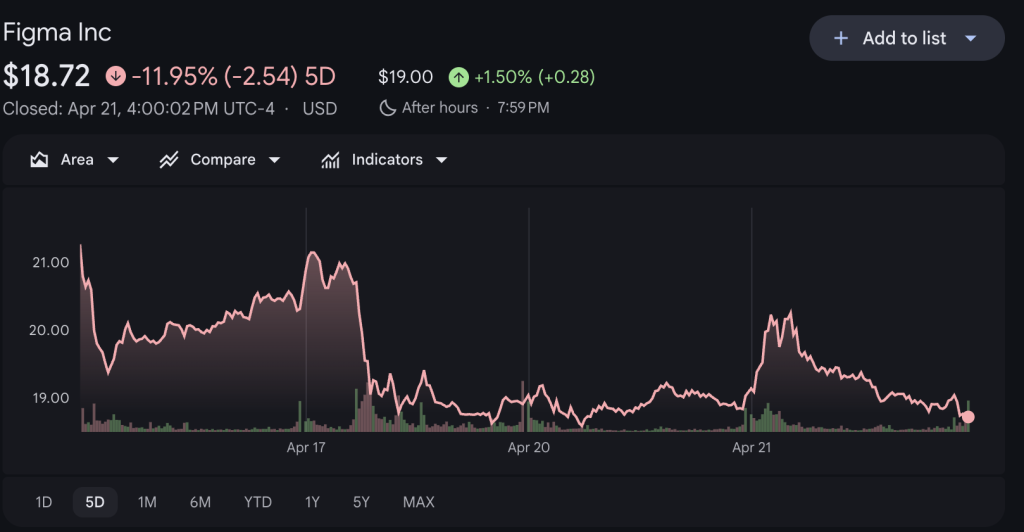
And Figma — the company Claude Design just took 7% off of — was paying Anthropic for compute.
This is the compute-competitor paradox, and it’s the real story connecting every headline in this issue. Figma paid the lab that shipped its competitor. Cursor paid every lab trying to eat it. Every vertical SaaS company that runs on frontier inference is currently renting the assassin. And the only exit anyone has found — as Cursor just demonstrated — is to sell a one-year call option on yourself to the one compute owner who doesn’t already have a competing product in your category.
Each of the big four labs is picking a completely different quadrant to defend, and the question is no longer which one wins but which one is about to marry your business. xAI is consolidating compute and selling exclusivity rights to products that need it. Cursor today, something else tomorrow. Anthropic is going vertical inside the enterprise — banking, law, design — and racing toward an $800 billion IPO on coworker economics. OpenAI is running three plays at once: sweep the image leaderboard, ship the next frontier model three days later, turn on CPC ads, land Codex at four million weekly users. Google is the fourth front: TPUs, owned data centers, scale nobody else can match on the infrastructure side, and now Sergey Brin un-retired specifically to “out-code Anthropic.” Founder mode got called out of retirement. Google Cloud Next opens tomorrow in Vegas with agentic AI as the banner.
Each bet is falsifiable. Each one is a completely different theory of what matters. And each one is hunting for a different customer. Coders will pay, and pay highly, for every marginal point of capability — which is why Anthropic is charging 2x the tokens of Opus 4.6 for the same effort level on Opus 4.7, and getting away with it. Consumers will not pay — which is why OpenAI is turning on ads and Meta is installing keystroke trackers on employee laptops to scrape AI training data off its own staff. (How would you like to work at Meta right now? You’re plugged into the matrix — right up until they flush you down a tube for a synthetic version that doesn’t take lunch breaks.) Enterprise pays slowly and is now openly wary of vendors that turn into competitors. The lesson of Figma this month is the lesson every enterprise operator is drawing in real time: your AI vendor is researching your replacement while collecting your subscription.
The real story: The frontier labs went horizontal this weekend. Your defensibility goes vertical. The labs can service your business, but they can only eat it if what you do is something a model can replicate at scale. Regulated workflows. Customer relationships measured in decades. Proprietary data no lab can license into a training set. Physical-world handoffs. Those are the verticals worth defending. And here’s the quieter truth underneath every story we’ve covered today: if you’re small enough, you’re invisible. Figma got eaten because Figma was big. A trillion-dollar cluster isn’t going to train on your thousand-customer niche. Being beneath the minimum economic deal size of the frontier labs is the new moat. Our April 19 piece on three-person AI-native companies wasn’t just a story about efficiency. It was the first draft of a survival guide.
What This Means For You
Three of the four biggest names in AI just got up off the mat in seventy-two hours. One of them fell off the bench. xAI turned compute into an acquisition primitive nobody had named yesterday. OpenAI reasserted itself in a category Anthropic isn’t even competing on, with a second frontier model rumored for Thursday. Sergey Brin un-retired. And the lab that’s been selling voluntary AI safety frameworks to Washington for six months just had its most dangerous model leak into a Discord.
Audit your vendor’s position in the stack. If your AI business runs on someone else’s GPUs, your vendor is either a landlord or a competitor. The Cursor deal is the template for every conversation coming next. Map your compute supply chain today — you have less time than you think.
Stop trusting voluntary lab controls as a security posture. The 40-organization Glasswing whitelist held for exactly zero weeks. Your stack’s safety assumptions are wrong until proven right. Pull the list of MCP-connected systems in your organization and decide what gets cut if the protocol underneath them leaks the way Mythos did.
Pick a vertical the labs can service but can’t eat. Regulated workflows. Physical-world handoffs. Customer relationships measured in decades. Proprietary data no lab can license. The frontier went horizontal this weekend. Your survival goes vertical.
If you’re small enough, you’re invisible. Figma got eaten because Figma was big. A trillion-dollar cluster is not going to train on your thousand-customer niche — the economics don’t work. Being beneath the minimum economic deal size of the frontier labs is the new moat. Being small used to be a disadvantage. This week it became a strategy.
Every major lab just declared a different theory of what matters. Every operator reading this has to figure out which lab is about to marry their business — and decide what they’re going to do about it before the vows. The coronation is off. The game is on.
Three Questions We Think You Should Be Asking Yourself
What’s your Colossus? If your business runs on someone else’s GPUs, which of the four compute owners — xAI, Amazon, Microsoft, Google — is eventually going to become your landlord, and what do you sell them to make them leave you alone? Cursor answered the question this week for $10 billion. The next twenty companies in that position won’t get a check that large. They’ll get a different one.
What voluntary control in your stack is holding the whole thing together? If the 40-organization Glasswing whitelist — the most publicly-scrutinized AI safety framework of 2026 — collapsed in weeks, what else are you running on faith? Name the specific assumption. Name the specific failure mode. Name the specific person responsible for verifying it’s still true. If you can’t, you have your answer.
Is your business on Anthropic’s roadmap — or beneath it? Figma was on the roadmap. Figma got 7% repriced the day Claude Design shipped. Your product is either specific enough to defend as a vertical that the labs can’t replicate at scale, or small enough that no lab will ever find you worth the training run. If the honest answer is “we’re in the middle” — a generalist tool with a wide surface area and no deep domain moat — you’re the kind of business that gets eaten in 2027. Pick a side.
“I’m gonna make him an offer he can’t refuse.”
— Don Vito Corleone, The Godfather
That’s the Cursor deal in one sentence. Elon made an offer Cursor couldn’t refuse, against a field that couldn’t match it. Every lab in AI just learned what the offer looks like when the compute moat finally gets monetized as M&A.
— Harry and Anthony
Sources
- Aligned News — Tuesday Night Analysis, April 21, 2026
- Cursor × SpaceX Partnership Announcement
- Akash Gupta — SpaceX-Cursor Deal Structure Analysis
- The Information — Cursor Training Composer 3 on Colossus
- Bloomberg — Unauthorized Users Bypass Anthropic Mythos Controls
- UK AI Security Institute — Mythos Evaluation
- CISA Still Locked Out of Mythos — via Aligned News
- Sam Altman on Anthropic Mythos — TechCrunch
- OpenAI GPT Image 2 Launch
- Image Arena Leaderboard — GPT Image 2 Sweeps Seven Categories
- OpenArt Integrates GPT Image 2
- Nate’s Newsletter — Opus 4.7 Is Smarter, More Literal, Quietly More Expensive
- Implicator.ai — Cook Steps Down, Bezos Raises Ten Billion, Nobody Owns the Bill
- Ars Technica — Anthropic Gets $5B Investment From Amazon, Will Use It to Buy Amazon Chips
- The Rundown — Sergey Brin’s Plan to Out-Code Anthropic
- Claude Design Launch — Anthropic
- APEX-Agents Investment Banking Leaderboard — Opus 4.7 #1
- Mozilla Fixes 151 Firefox Bugs Using Mythos
More like this

Cars and Trucks and Things That Go
Midjourney built a body scanner that's half real breakthrough, half science-fiction sales pitch, and telling the two apart is the only skill that matters now. The cynic can't. The hype man won't. Be amazed and stay skeptical; they're the same muscle
Coffee’s for Closers
The CFO finally read the inference bill and walked in with a lawnmower. The companies that make it through the quarter won't own the smartest model — they'll know exactly which workloads earn a frontier token and which ones ride the cheap bench

Show Me Where to Put the Fulcrum
Give me a lever long enough, and show me where to put the fulcrum, and I will move the world. The lever just became free — so placement is the only thing left worth knowing.